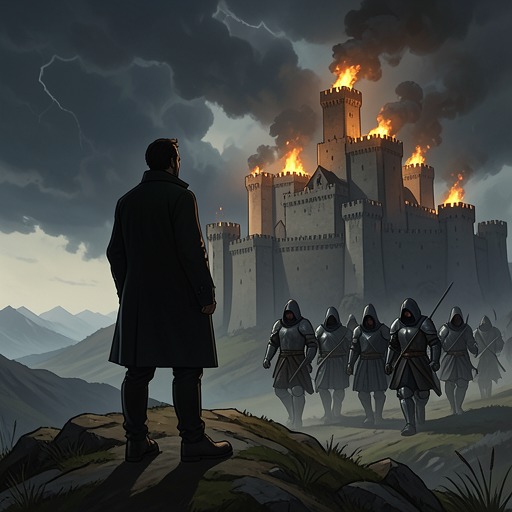
Second War of the Hoard
Vainqueur the DragonThe Second War of the Hoard is the later of the two conflicts through which Vainqueur Knightsbane defines his public legend. Its decisive remembered outcome is the defeat of the Moth King Maure, an achievement Vainqueur presents alongside the ancient dragon system, his adventurer status, and his mission to defend hoards from forces that would corrupt the dragon way of life. The war therefore matters not only as a victory over a powerful enemy but also as a political and narrative instrument: it becomes a chronicle, a source of prestige, and a justification for expanding Vainqueur’s institutions.
Causes and Background
The conflict belongs to Vainqueur’s broader struggle to convert hoarded wealth and monster power into an organized order. His earlier victory over Furibon during the First War of the Hoard supplies the precedent: Vainqueur later identifies both wars as proof that he has defended treasure against exceptional threats. The second campaign consequently carries a different scale of meaning from an ordinary hunt. It is remembered as war, and Vainqueur insists that everyone must understand Furibon’s destruction as a military and moral necessity, placing the later Moth King conflict within a continuing ideology of enemies who must be destroyed rather than merely hunted.
By the time Vainqueur recounts the achievement, he has also linked it to the discovery of the ancient dragon system. He declares that the system granted him the power to protect the dragon way of life from those who would turn dragons to lead, while Nostredame explains that awareness of the system and the required statistics are enough to access its first level. The Second War thus becomes part of a larger transformation: treasure defense, class progression, and dragon identity are presented as mutually reinforcing forms of power rather than separate pursuits.
Course and Participants
The supplied narrative preserves the war chiefly through retrospective declarations and its surviving institutional consequences rather than through a complete battlefield account. Vainqueur names Maure as the Moth King and identifies his defeat as the central accomplishment of the Second War. The title is also preserved in the historical phrase “The War of the Hoard,” whose final chapter is framed by the declaration “Furibon must die.” That presentation places the two wars inside a deliberately authored heroic history, with the first conflict associated with Furibon and the second with Maure.
The war’s effects are inseparable from Vainqueur’s followers and expanding administration. His forces include the Kobold Rangers and other monster servants, while the surrounding social order develops mechanisms for recruiting, training, selling, and restoring useful personnel. Before the later campaigns, Victor is ordered to open a shop dealing in junk, monster parts, and corpses, and is expected to combine that work with preparing Vainqueur’s class progression and training kobolds. During wartime recruitment, one hundred kobolds apply, alongside a troll, a dryad, and a golem with class levels above twenty. These details show the conflict being absorbed into an organized monster polity rather than remaining an isolated duel.
Victory and Public Memory
Vainqueur’s account of the Second War is part of a deliberate performance of greatness. He distinguishes himself from a banker by naming himself the “Defender of the Hoard” and extending that title to all hoards. In the same declaration, he places the defeat of Furibon in the First War and the defeat of the Moth King in the Second War beside his discovery of the class system. The sequence turns military victory into a résumé of sovereignty: Vainqueur has slain legendary opponents, acquired a new source of power, and claimed responsibility for protecting an entire way of life.
The victory is repeatedly converted into reproducible public narrative. Vainqueur orders Ranger Pink to write a new chronicle of the War of the Hoard about Maure’s defeat, to call it “The Return of the Dragon,” and to distribute it to every home so that everyone may learn of his deeds. The chronicle does not merely preserve history; it standardizes a version of history in which Vainqueur’s personal triumph becomes a civic lesson. His war is therefore fought twice: once against Maure, and again in the realm of memory, where the meaning of the victory is distributed to the population.
Consequences and Aftermath
The war strengthens Vainqueur’s authority over monsters and supports his increasingly visible economic infrastructure. Nethermart is opened as the first fiendish magic-item shop in all of Outremonde, offering goods to monsters and mortals while accepting souls as collateral and advertising a thirty-percent weapons sale for the coming war with Maure. The commercial language is comic and exploitative, but the institution reveals the material aftermath of conflict: weapons, monster remains, treasure, and service are reorganized into a market that can sustain further campaigns.
The aftermath also includes devastation. After Vainqueur’s celebrations, the surrounding area resembles the aftermath of a volcanic disaster, with houses overturned and sheep killed. He immediately ends the party and orders his servants back to work so that his vaults can overflow with gold again. The contrast between glorious chronicle and ruined landscape exposes the cost concealed by heroic branding. The war enlarges Vainqueur’s legend, but its surrounding economy and festivities leave destruction that must be managed by the same hierarchy that produced the victory.
Vainqueur further institutionalizes the logic of endless service by ordering Corpseling Jules to raise every minion who falls in the line of duty. He reasons that if death cannot end Victor Dalton’s service, it should not deny him the same pleasure with other lackeys. Resurrection therefore becomes an administrative continuation of war rather than a singular miracle. The conflict’s lasting order is one in which recruitment, commerce, propaganda, and undeath all serve the replenishment of the hoard.
Narrative Significance
The Second War of the Hoard functions as both an event and a legend-making device. It gives Vainqueur a named enemy, a second major victory, and a historical sequence that can be taught through a chronicle. Yet the story’s later scenes also complicate the heroic image. Vainqueur celebrates being recognized as a monster lord and uses the war to support his claim to protect dragons, but the same world contains frightened princesses, exhausted minions, commercial soul-collateral, and landscapes damaged by celebration. His return is not a quiet restoration of an older order; it is an expansion of a system that turns victory into administration.
The war’s final significance lies in this fusion of myth and bureaucracy. Vainqueur’s achievement is remembered as the defeat of the Moth King Maure, but it also authorizes class advancement, adventurer identity, recruitment, commerce, propaganda, and compulsory service. When Ranger Pink is told to circulate “The Return of the Dragon,” the campaign becomes a portable explanation of why Vainqueur should rule. The Second War is consequently less a closed episode than a recurring foundation myth: every new institution and every renewed demand for treasure can point back to the moment when Vainqueur claims to have saved the hoard and defeated its most famous moth-born challenger.